Waves of Migration, One Human Family
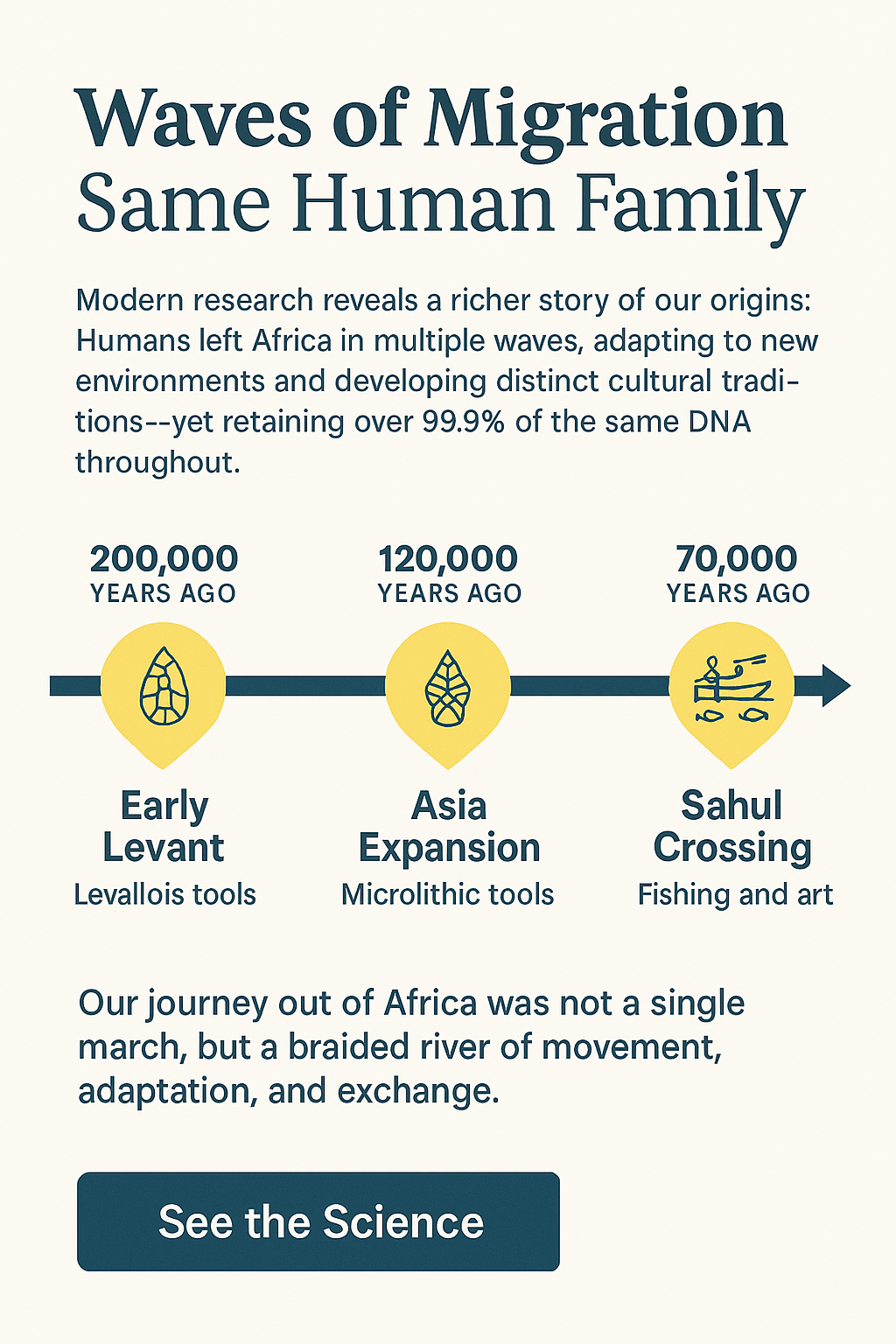
Modern research reveals a richer story of our origins: humans left Africa in multiple waves, adapting to new environments and developing distinct cultural traditions — yet retaining over 99.9% of the same DNA throughout.
The Single-Exodus Story
For decades, scientists believed our species left Africa in one major migration around 50–70,000 years ago. This “single-exodus” model explained the spread of Homo sapiens across the globe — but new evidence suggests the truth is more complex.
Multiple Waves, Many Paths
Fossils, tools, and genetic data now point to several dispersals, some as early as 200,000 years ago. These groups encountered different climates, landscapes, and neighboring hominin species, shaping unique cultural expressions.
- Early Levant: Levallois stone-flaking techniques
- South & Southeast Asia: Early microlithic tools
- Australia & Sahul: Fishing and navigation innovations
Unity Beneath Diversity
Despite these regional differences, genetic studies show that all modern humans remain extraordinarily similar. The small variations we see are mostly adaptations to local environments — not markers of separate kinds of people.
- 99.9% genetic similarity across all humans
- Greater variation within populations than between them
- Shared ancestry linking every person alive today
The Secret of Our Success
Recent findings (2025-2026) show that the wave of ancestors who settled the globe 50,000 years ago succeeded because they had developed a "universal human niche."
They didn't need to change their biological hardware to survive in rainforests, deserts, or tundras; they used their shared 99.9% ingenuity to adapt to every environment on Earth. This flexibility is a core feature of our single human family.
Tracing the Waves
Explore the key migration waves, their approximate dates, and the cultural innovations they carried with them.
One Story, Many Chapters
Our journey out of Africa was not a single march, but a braided river of movement, adaptation, and exchange. The remarkable truth is that through it all, we have remained one family.
See the Science