The science is settled. Every human being on Earth shares more than 99.9% of the same DNA. We are, without question, one extended family — genetically related across every border, every language, every faith, every culture that has ever existed.
But knowing a truth and truly accepting it are different things. What follows is not a scientific argument. It is an invitation to imagine what becomes possible the moment this truth moves from the mind into the way we actually live.
99.9% — One Human FamilyThe Individual Shift
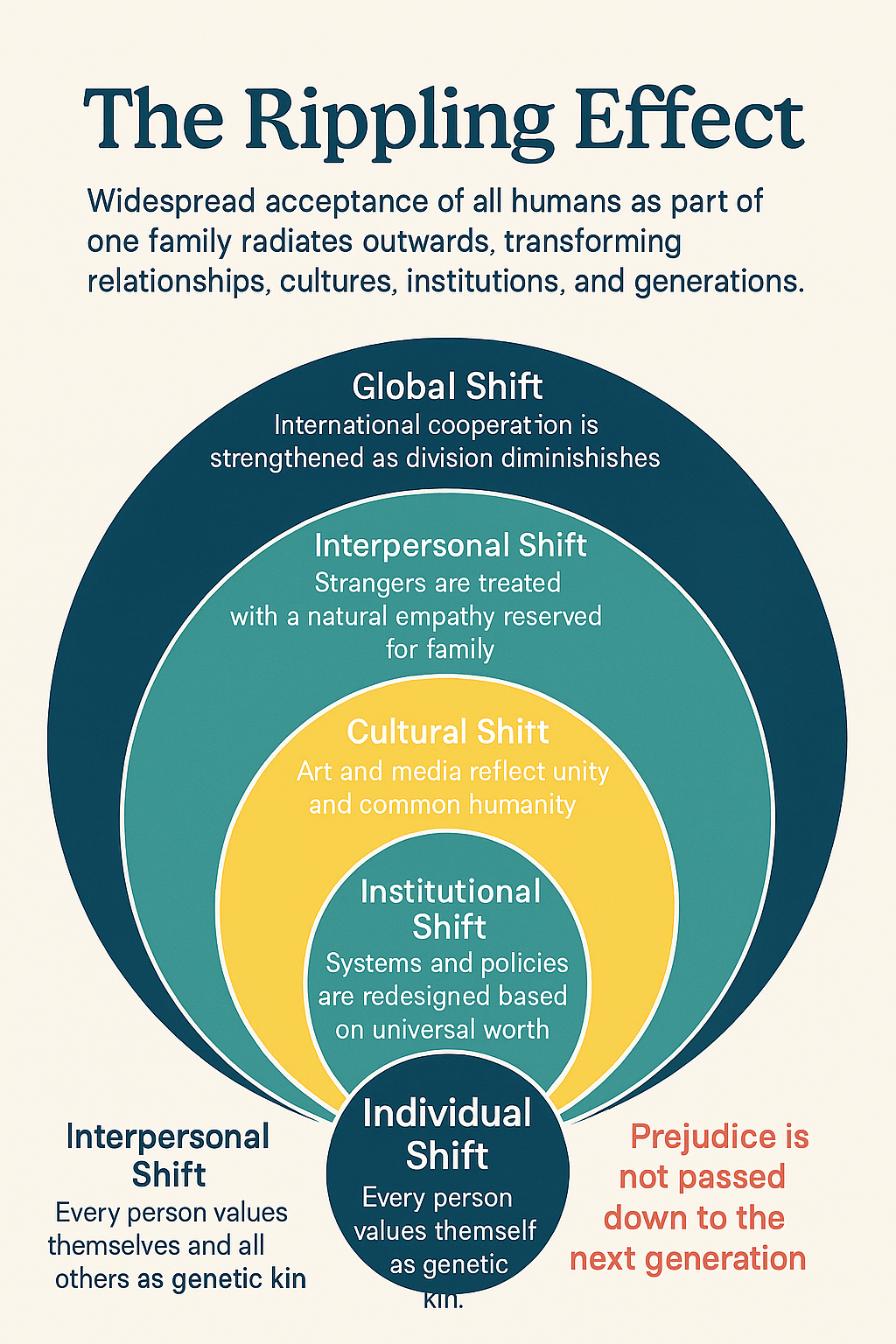
Every ripple begins at the center. And the center is you — one person, in one moment, choosing to truly internalize what the science has already confirmed.
When a person genuinely accepts that every other human being is their genetic kin, something changes in how they move through the world. The stranger on the street is no longer a stranger in any meaningful sense. The person whose beliefs, appearance, or background differ from yours is no longer other — they are family, separated only by the particular set of experiences and circumstances that shaped their life rather than yours.
This is not a call to ignore difference. Difference is real and valuable. It is a call to locate difference in its proper place — as variation within a family, not division between separate kinds of people. Families contain multitudes. They disagree, they surprise each other, they hold contradictory views. But they do not treat each other as fundamentally less.
The individual shift is quiet. It may not show up immediately in grand gestures. It shows up first in how you listen, how you assume, and what you allow yourself to feel when you encounter someone whose life looks nothing like yours.
The Interpersonal Shift
The second ripple moves outward from the individual into every relationship they carry — with neighbors, colleagues, classmates, strangers, and everyone whose life briefly or permanently intersects with theirs.
Prejudice has always depended on a fiction: that certain people are a fundamentally different kind of human. That fiction has dressed itself in the language of science for centuries, borrowing authority it was never entitled to. Modern genetics has revoked that authority entirely. There is no biological basis for treating another person as less. The moment that fiction loses its disguise, prejudice has nowhere left to stand.
In schools, workplaces, neighborhoods, and public spaces, the interpersonal shift means that empathy becomes the default rather than the exception. It means that the automatic distance many people maintain from those who look or speak differently begins to close — not through obligation or performance, but because the underlying belief has changed.
Conflict does not disappear. Families argue. But the nature of conflict changes when it is no longer rooted in the belief that the other person is a lesser form of human. Disagreements become navigable. Resolution becomes conceivable.
The Cultural Shift
Culture is the water we swim in — so pervasive and familiar that it becomes invisible. It shapes what stories get told, whose history gets taught, which lives are centered and which are treated as peripheral. When the foundational belief changes, culture changes with it.
Art and media that once reflected separation as natural begin to tell different stories. Not stories of enforced sameness — the richness of human cultural diversity is one of the great gifts of our shared journey — but stories that locate that diversity within a single human family rather than between competing tribes. The frame shifts from division to variation. From hierarchy to difference.
Education changes perhaps most profoundly. Children who grow up learning that they are biologically kin to every other child on Earth carry that understanding into every class, every playground, every relationship they build. History taught as a single human story — one species, migrating, adapting, creating, and connecting across millennia — is a truer history than the one divided neatly by race and nation.
Cultural shifts are slow. They move across generations more than news cycles. But they are also the most durable changes of all — because once a culture genuinely believes something different, the old belief becomes literally unthinkable to those born after it.
The Institutional Shift
Institutions are culture made permanent — the rules, systems, and structures that carry a society's assumptions into law, policy, and practice. For centuries, many of the world's institutions were built on the assumption that human beings are divided into meaningfully different biological categories. Those assumptions shaped laws, determined access, allocated resources, and decided whose life the system was designed to protect.
When the underlying belief changes, institutions built on the old belief become legible in a new way. Systems that once sorted people into categories that do not biologically exist can be seen clearly for what they are — not natural arrangements, but choices made at a particular moment in history that can be unmade and remade.
This is not abstract. Public health systems that operate from a premise of shared human stake make different decisions than those built on hierarchies of worth. Justice systems that begin from the assumption of equal human dignity produce different outcomes. Educational institutions that treat every student as equally capable of growth and contribution build different environments than those that have sorted children into categories of promise.
The institutional shift is the hardest and the slowest of the ripples. Institutions resist change by design. But they have changed before, and the changes that endure are always the ones rooted in a deeper and more accurate understanding of what is actually true.
The Global Shift
The fifth ripple reaches the scale of the whole — the international systems, agreements, and conflicts that shape life for billions of people who will never meet each other but whose futures are inextricably linked.
The "us versus them" frame that has governed international relations for centuries depends on the same underlying fiction as personal prejudice: that people on the other side of a border are a fundamentally different kind of human whose interests are naturally in conflict with ours. Strip that fiction away and the logic of zero-sum competition weakens dramatically.
Migration, approached as the movement of family members rather than the encroachment of outsiders, becomes a different conversation. Climate change, understood as a threat to a shared home that every human being depends on, becomes a different kind of emergency — one that demands the cooperation of kin rather than the negotiation of rivals. Resource sharing, framed as the responsibility of a family to its members rather than the sacrifice of one nation for another, finds different political ground.
None of this is naive. The history of human conflict is real and its causes are complex. But every major step toward international cooperation in human history has required a prior shift in how people understood their relationship to those beyond their immediate group. The genetic truth is perhaps the most solid foundation that shift has ever had.
The Generational Shift
The outermost ripple moves beyond any single lifetime. It belongs to the children not yet born, who will inherit either the divisions we failed to question or the understanding we were willing to build.
Bias is learned. This is one of the most important findings in the psychology of prejudice — and one of the most hopeful. Children are not born believing that certain people are fundamentally inferior or other. They learn it, from the cultures, families, and institutions that surround them. What is learned can be unlearned. And what is never taught does not need to be unlearned at all.
A generation raised with the genetic truth as common knowledge — not as a radical claim but as an unremarkable fact, as settled and obvious as any other piece of science — does not need to do the hard work of dismantling beliefs they were never given. They begin from a different starting point entirely. The ceiling of what they are able to imagine, about cooperation, about belonging, about the scope of human community, is simply higher than ours.
This is the most profound ripple. Not because it is the largest — though it is — but because it is the one that makes all the others permanent. Individual shifts fade. Cultural shifts can be reversed. But a generation that grows up without inheriting the falsehood does not need to fight it. They simply build what comes next, from the truth, as their natural starting point.
From Truth to Possibility
Acceptance of truth is not the end of the story. It is the beginning of a new one. The question is no longer "Are we one family?" The science has answered that. The question now is simply: "What will we build, knowing that we are?"
Every ripple begins with one person choosing to truly see another — not as other, not as stranger, not as threat — but as kin.