The science of human similarity
Researchers across anthropology, biology, and medicine agree: race is a social construct, not a genetic category. The idea of biologically distinct human “races” — once promoted under scientific racism — has been discredited. What we call “racial differences” are superficial expressions of our shared genetic heritage, shaped by environmental adaptation over tens of thousands of years.
What is a subspecies?
In biology, a subspecies is a formally recognized taxonomic rank below species. It’s used when populations:
- Geographic isolation: Are separated long enough to follow distinct evolutionary paths.
- Consistent differences: Show diagnosable, stable differences in appearance, genetics, or behavior.
- Partial divergence: Differ more than normal individual variation, but still interbreed successfully.
Examples include Bengal vs. Siberian tigers, or African savanna vs. forest elephants — cases with strong morphological distinctions and measurable genetic distances.
Why humans don’t qualify as separate races or even subspecies
- Low overall variation: Human genetic diversity is extremely low compared to many animals.
- Weak between-group distance: Population genetic measures (like FST) between continental groups are modest, far below typical subspecies thresholds in other species.
- Constant gene flow: Migration and interbreeding across history prevent the long isolation needed for subspecies formation.
- No hard boundaries: Human genetic variation changes gradually across geography, not in discrete blocks.
If we applied animal criteria to humans, we would classify everyone as one subspecies: Homo sapiens sapiens.
We Are One Species — The 0.1% Illusion
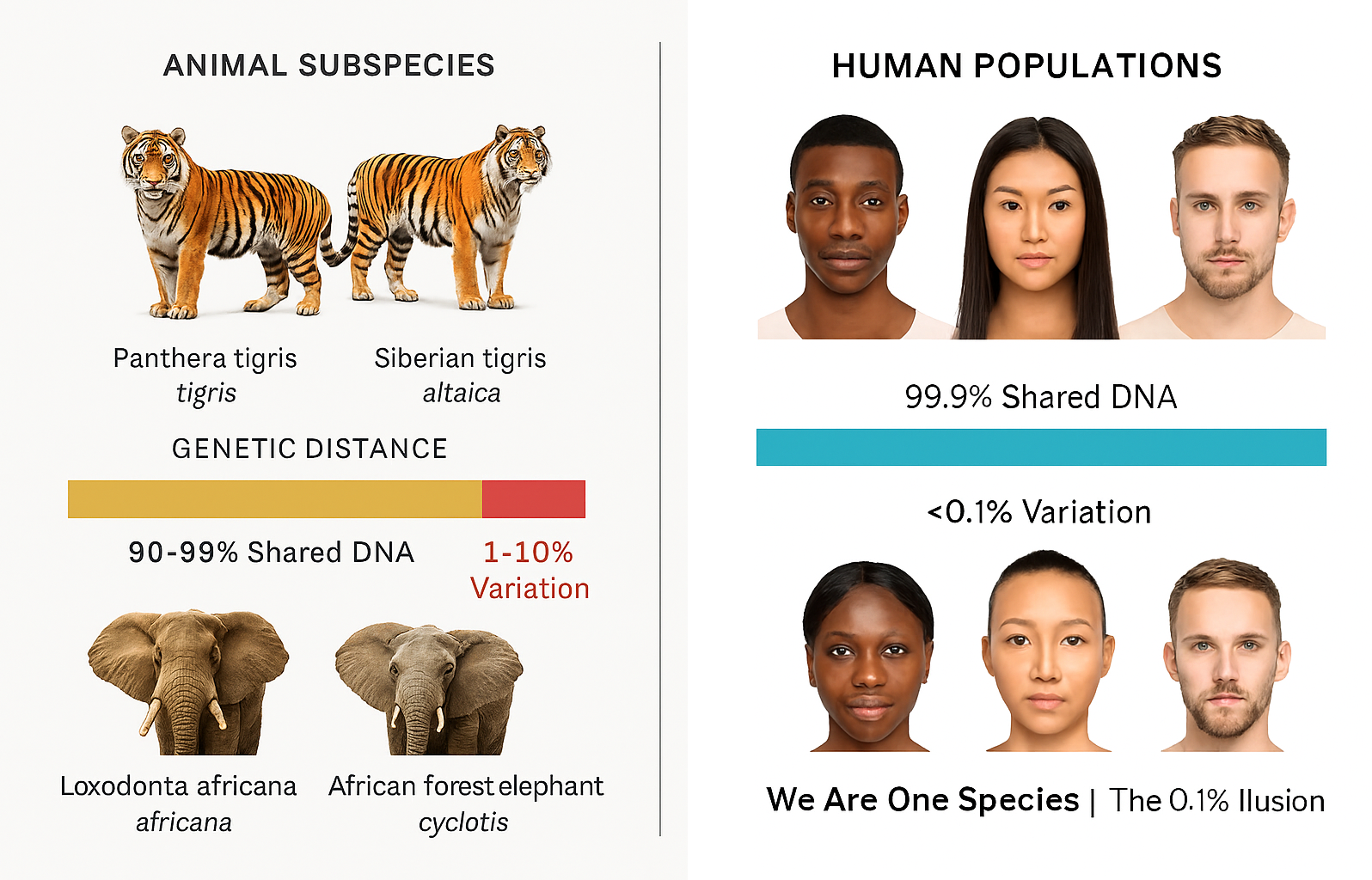
Impossible to be a legitimate racist: genetic testing proves we are all part of one race, with not even multiple human subspecies to discriminate between us.
The bottom line
It is scientifically impossible to be a “legitimate” racist in the biological sense — there are no separate human subspecies to discriminate between. Racism is real as a social and historical force, but it rests on a biological fiction. Ending racism begins with ending belief in that fiction — and replacing it with the evidence-based truth of kinship.
Share the 0.1% illusion
Use this visual in classrooms, talks, and posts. When people see the scale of our similarity, the story of separation loses power.
- Download visual: multiple-races-illusion.png
- Embed code:
<img src="/images/multiple-races-illusion.png" alt="We are one species — the 0.1% illusion." />
